 Add to Chrome
 Add to Firefox
 Add to Edge
FedSmoothLoRA: Toward Smoother and Faster Convergence in Federated Low-Rank Adaptation
May 28, 2026
Federated fine-tuning of foundation models with Low-Rank Adaptation (LoRA) provides an efficient solution for reducing communication and computation costs while preserving data locality. However, the direct combination of FedAvg and LoRA suffers from three key issues: limited update space, which restricts the model's effective learning capacity; inter-round state mismatch, which disrupts cross-round local optimization continuity; and a client-agnostic starting state, which slows local convergence on clients. Although recent methods mitigate the limited update space issue by merging LoRA updates into the backbone across communication rounds, inter-round state mismatch and the client-agnostic starting state remain insufficiently addressed. To address these issues, we propose FedSmoothLoRA, a federated LoRA tuning framework that preserves the enlarged update space, improves cross-round local optimization continuity, and provides a client-aware starting state for local training. At each communication round, FedSmoothLoRA constructs the local LoRA initialization using two matrices: a Round-Matching matrix that preserves cross-round local state continuity, and a Gradient-Aligned matrix that provides client-specific optimization guidance from gradient signals estimated on local data. Together, these designs enable smoother and faster convergence. Extensive experiments on image classification and natural language generation tasks demonstrate that FedSmoothLoRA consistently outperforms existing federated LoRA tuning methods. Code: https://github.com/wangzehao0704/FedSmoothLoRA

AnE: Pushing the Reasoning Frontier of Multimodal LLMs via Anchor Evolution
May 25, 2026Post-training via Supervised Fine-Tuning (SFT) and Reinforcement Learning (RL) is crucial for enhancing reasoning in Multimodal Large Language Models (MLLMs), yet existing paradigms often reach a performance bottleneck due to the limitations of static data. While current methods leverage self-reflection or self-evolution to push these boundaries, they still suffer from cognitive drift and hallucinated reasoning paths caused by low-quality synthetic data. To address these challenges, we propose Anchor Evolution (AnE), a new paradigm that integrates truth-anchored data curation and model evolution, achieving faithful and steady performance gains at the reasoning frontier. Specifically, we propose Truth Anchor Expansion, which pinpoints the model failing frontier via trajectory rollouts and leverages ground-truth databases to retrieve high-fidelity anchors for faithful data curation. Subsequently, we introduce the Scaffold-Stripping Mechanism to internalize reasoning capabilities. This mechanism first anchors reasoning paths via scaffold-augmented supervision to mitigate the learning complexity and distribution drift of direct SFT on raw data, then leverages RL to strip the scaffold template, thereby effectively transitioning the reasoning paths into intrinsic model capabilities. Experimental results on multimodal reasoning benchmarks show that our method substantially advances the model performance frontier, improving the base model by 10.3\% across eight multimodal benchmarks and achieving state-of-the-art results. The code will be made publicly available.
Premier: Personalized Preference Modulation with Learnable User Embedding in Text-to-Image Generation
Mar 21, 2026Text-to-image generation has advanced rapidly, yet it still struggles to capture the nuanced user preferences. Existing approaches typically rely on multimodal large language models to infer user preferences, but the derived prompts or latent codes rarely reflect them faithfully, leading to suboptimal personalization. We present Premier, a novel preference modulation framework for personalized image generation. Premier represents each user's preference as a learnable embedding and introduces a preference adapter that fuses the user embedding with the text prompt. To enable accurate and fine-grained preference control, the fused preference embedding is further used to modulate the generative process. To enhance the distinctness of individual preference and improve alignment between outputs and user-specific styles, we incorporate a dispersion loss that enforces separation among user embeddings. When user data are scarce, new users are represented as linear combinations of existing preference embeddings learned during training, enabling effective generalization. Experiments show that Premier outperforms prior methods under the same history length, achieving stronger preference alignment and superior performance on text consistency, ViPer proxy metrics, and expert evaluations.
PCEvo: Path-Consistent Molecular Representation via Virtual Evolutionary
Jan 27, 2026Molecular representation learning aims to learn vector embeddings that capture molecular structure and geometry, thereby enabling property prediction and downstream scientific applications. In many AI for science tasks, labeled data are expensive to obtain and therefore limited in availability. Under the few-shot setting, models trained with scarce supervision often learn brittle structure-property relationships, resulting in substantially higher prediction errors and reduced generalization to unseen molecules. To address this limitation, we propose PCEvo, a path-consistent representation method that learns from virtual paths through dynamic structural evolution. PCEvo enumerates multiple chemically feasible edit paths between retrieved similar molecular pairs under topological dependency constraints. It transforms the labels of the two molecules into stepwise supervision along each virtual evolutionary path. It introduces a path-consistency objective that enforces prediction invariance across alternative paths connecting the same two molecules. Comprehensive experiments on the QM9 and MoleculeNet datasets demonstrate that PCEvo substantially improves the few-shot generalization performance of baseline methods. The code is available at https://anonymous.4open.science/r/PCEvo-4BF2.
DeepSynth-Eval: Objectively Evaluating Information Consolidation in Deep Survey Writing
Jan 07, 2026The evolution of Large Language Models (LLMs) towards autonomous agents has catalyzed progress in Deep Research. While retrieval capabilities are well-benchmarked, the post-retrieval synthesis stage--where agents must digest massive amounts of context and consolidate fragmented evidence into coherent, long-form reports--remains under-evaluated due to the subjectivity of open-ended writing. To bridge this gap, we introduce DeepSynth-Eval, a benchmark designed to objectively evaluate information consolidation capabilities. We leverage high-quality survey papers as gold standards, reverse-engineering research requests and constructing "Oracle Contexts" from their bibliographies to isolate synthesis from retrieval noise. We propose a fine-grained evaluation protocol using General Checklists (for factual coverage) and Constraint Checklists (for structural organization), transforming subjective judgment into verifiable metrics. Experiments across 96 tasks reveal that synthesizing information from hundreds of references remains a significant challenge. Our results demonstrate that agentic plan-and-write workflows significantly outperform single-turn generation, effectively reducing hallucinations and improving adherence to complex structural constraints.
Klear-AgentForge: Forging Agentic Intelligence through Posttraining Scaling
Nov 08, 2025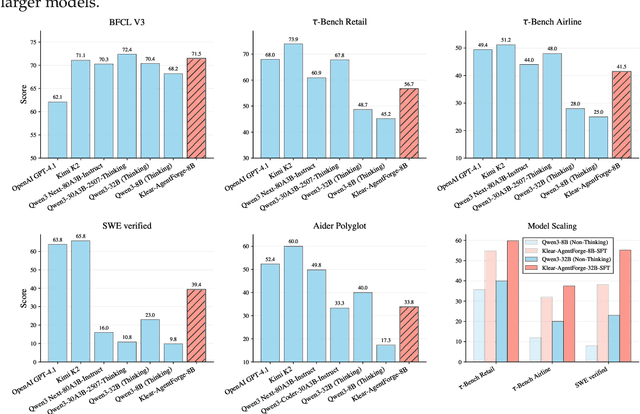
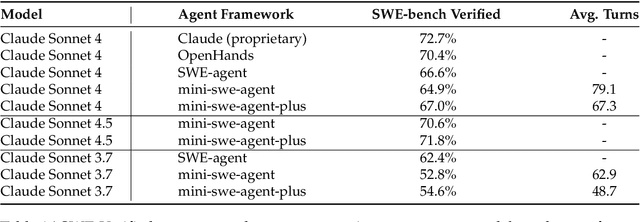
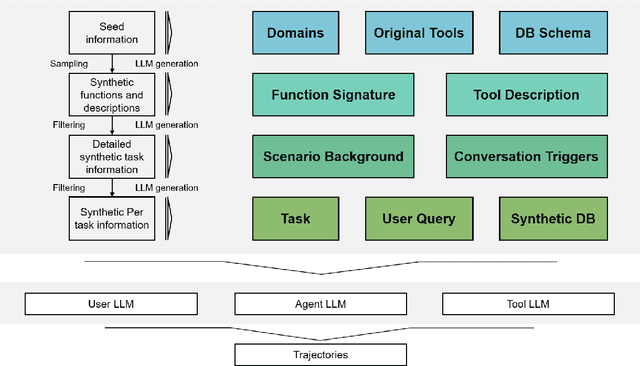
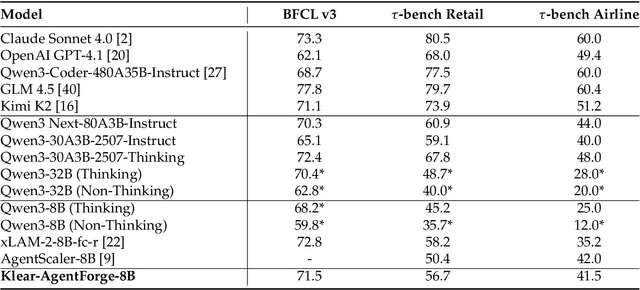
Despite the proliferation of powerful agentic models, the lack of critical post-training details hinders the development of strong counterparts in the open-source community. In this study, we present a comprehensive and fully open-source pipeline for training a high-performance agentic model for interacting with external tools and environments, named Klear-Qwen3-AgentForge, starting from the Qwen3-8B base model. We design effective supervised fine-tuning (SFT) with synthetic data followed by multi-turn reinforcement learning (RL) to unlock the potential for multiple diverse agentic tasks. We perform exclusive experiments on various agentic benchmarks in both tool use and coding domains. Klear-Qwen3-AgentForge-8B achieves state-of-the-art performance among LLMs of similar size and remains competitive with significantly larger models.
Zero-Shot Learning with Subsequence Reordering Pretraining for Compound-Protein Interaction
Jul 28, 2025Given the vastness of chemical space and the ongoing emergence of previously uncharacterized proteins, zero-shot compound-protein interaction (CPI) prediction better reflects the practical challenges and requirements of real-world drug development. Although existing methods perform adequately during certain CPI tasks, they still face the following challenges: (1) Representation learning from local or complete protein sequences often overlooks the complex interdependencies between subsequences, which are essential for predicting spatial structures and binding properties. (2) Dependence on large-scale or scarce multimodal protein datasets demands significant training data and computational resources, limiting scalability and efficiency. To address these challenges, we propose a novel approach that pretrains protein representations for CPI prediction tasks using subsequence reordering, explicitly capturing the dependencies between protein subsequences. Furthermore, we apply length-variable protein augmentation to ensure excellent pretraining performance on small training datasets. To evaluate the model's effectiveness and zero-shot learning ability, we combine it with various baseline methods. The results demonstrate that our approach can improve the baseline model's performance on the CPI task, especially in the challenging zero-shot scenario. Compared to existing pre-training models, our model demonstrates superior performance, particularly in data-scarce scenarios where training samples are limited. Our implementation is available at https://github.com/Hoch-Zhang/PSRP-CPI.
RLEP: Reinforcement Learning with Experience Replay for LLM Reasoning
Jul 10, 2025

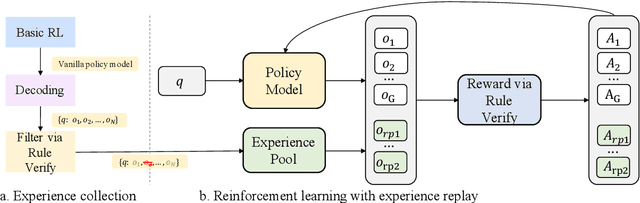
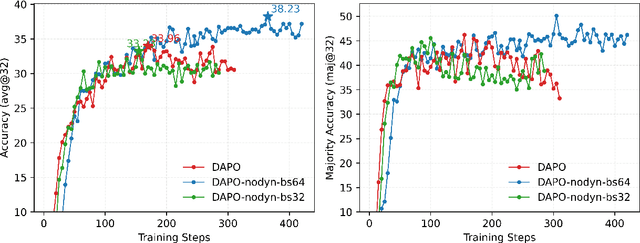
Reinforcement learning (RL) for large language models is an energy-intensive endeavor: training can be unstable, and the policy may gradually drift away from its pretrained weights. We present \emph{RLEP}\, -- \,Reinforcement Learning with Experience rePlay\, -- \,a two-phase framework that first collects verified trajectories and then replays them during subsequent training. At every update step, the policy is optimized on mini-batches that blend newly generated rollouts with these replayed successes. By replaying high-quality examples, RLEP steers the model away from fruitless exploration, focuses learning on promising reasoning paths, and delivers both faster convergence and stronger final performance. On the Qwen2.5-Math-7B base model, RLEP reaches baseline peak accuracy with substantially fewer updates and ultimately surpasses it, improving accuracy on AIME-2024 from 38.2% to 39.9%, on AIME-2025 from 19.8% to 22.3%, and on AMC-2023 from 77.0% to 82.2%. Our code, datasets, and checkpoints are publicly available at https://github.com/Kwai-Klear/RLEP to facilitate reproducibility and further research.
Evaluating Multimodal Large Language Models on Video Captioning via Monte Carlo Tree Search
Jun 11, 2025Video captioning can be used to assess the video understanding capabilities of Multimodal Large Language Models (MLLMs). However, existing benchmarks and evaluation protocols suffer from crucial issues, such as inadequate or homogeneous creation of key points, exorbitant cost of data creation, and limited evaluation scopes. To address these issues, we propose an automatic framework, named AutoCaption, which leverages Monte Carlo Tree Search (MCTS) to construct numerous and diverse descriptive sentences (\textit{i.e.}, key points) that thoroughly represent video content in an iterative way. This iterative captioning strategy enables the continuous enhancement of video details such as actions, objects' attributes, environment details, etc. We apply AutoCaption to curate MCTS-VCB, a fine-grained video caption benchmark covering video details, thereby enabling a comprehensive evaluation of MLLMs on the video captioning task. We evaluate more than 20 open- and closed-source MLLMs of varying sizes on MCTS-VCB. Results show that MCTS-VCB can effectively and comprehensively evaluate the video captioning capability, with Gemini-1.5-Pro achieving the highest F1 score of 71.2. Interestingly, we fine-tune InternVL2.5-8B with the AutoCaption-generated data, which helps the model achieve an overall improvement of 25.0% on MCTS-VCB and 16.3% on DREAM-1K, further demonstrating the effectiveness of AutoCaption. The code and data are available at https://github.com/tjunlp-lab/MCTS-VCB.
DynTok: Dynamic Compression of Visual Tokens for Efficient and Effective Video Understanding
Jun 04, 2025Typical video modeling methods, such as LLava, represent videos as sequences of visual tokens, which are then processed by the LLM backbone for effective video understanding. However, this approach leads to a massive number of visual tokens, especially for long videos. A practical solution is to first extract relevant visual information from the large visual context before feeding it into the LLM backbone, thereby reducing computational overhead. In this work, we introduce DynTok, a novel \textbf{Dyn}amic video \textbf{Tok}en compression strategy. DynTok adaptively splits visual tokens into groups and merges them within each group, achieving high compression in regions with low information density while preserving essential content. Our method reduces the number of tokens to 44.4% of the original size while maintaining comparable performance. It further benefits from increasing the number of video frames and achieves 65.3% on Video-MME and 72.5% on MLVU. By applying this simple yet effective compression method, we expose the redundancy in video token representations and offer insights for designing more efficient video modeling techniques.